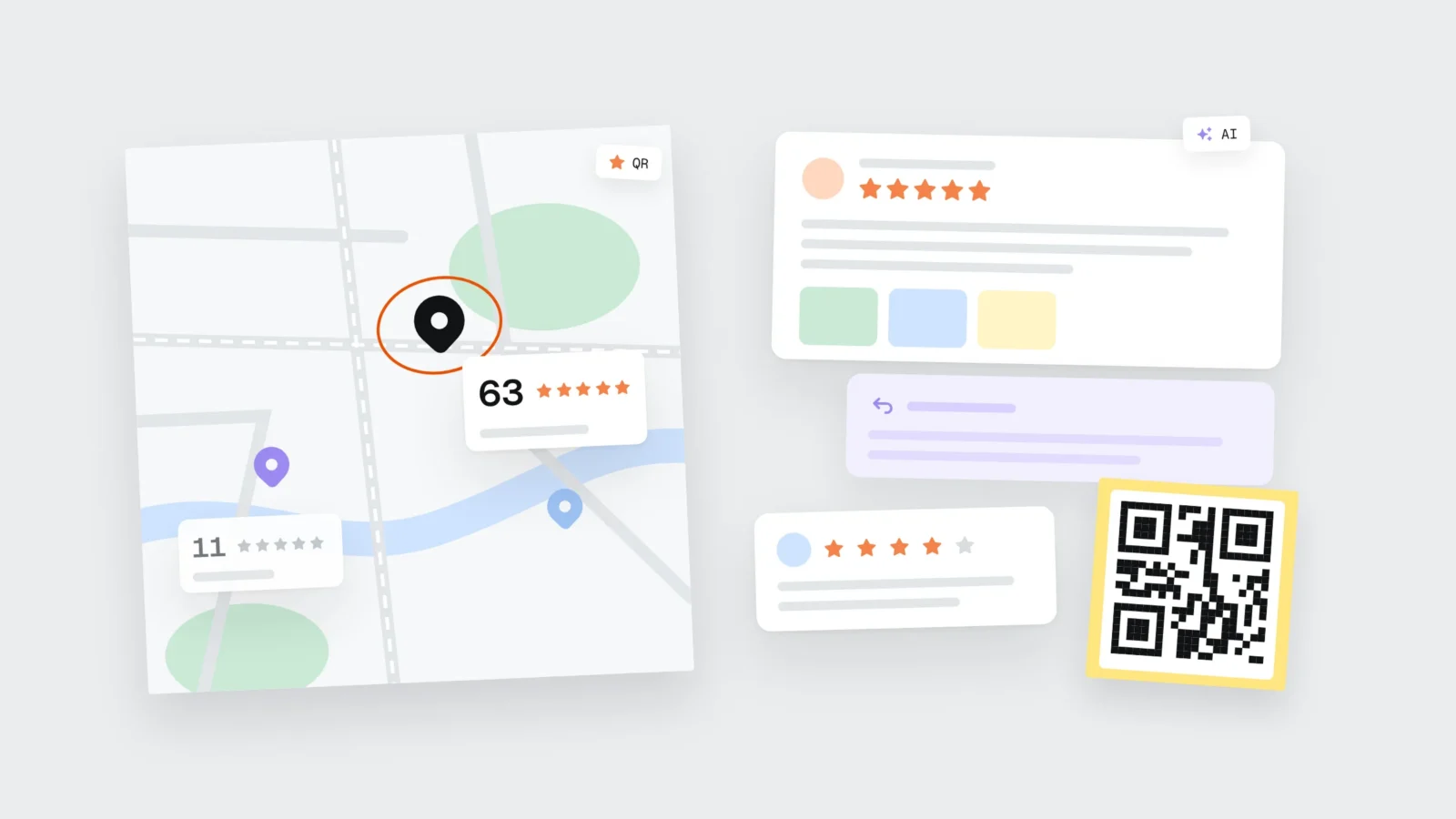
In 2026, Google reviews affect three places where customers find you. In Google Maps they feed prominence, which Google lists as one of the three foundations of local ranking alongside relevance and distance: more reviews and good ratings help you appear higher. In regular search and in AI answers (Google AI Overviews, Gemini features in Google Maps, ChatGPT), the text of your reviews becomes the material AI uses to summarise what customers praise and what they complain about. For a small business, more reviews come honestly from one simple habit: ask every customer right after the job, with a direct link or a QR code, and reply to every review. You may not offer a discount, a gift or money for a review, and you may not ask only happy customers. Google’s rules forbid both, and in Latvia fake reviews are also banned by the Unfair Commercial Practices Prohibition Law.
Our own dizainsweb Google profile has 13 Google reviews, a 5.0 rating, and that is not many. For years our clients recommended us to each other by word of mouth, but Google Maps and AI assistants cannot see word of mouth. We started collecting reviews deliberately fairly recently, and most of them arrived within the last year. So we researched this topic for ourselves as well.
How reviews affect your position in Google Maps
Google’s help page explains local results with three factors. Relevance is how well a profile matches the search. Distance is how far the business is from the person searching. Prominence is how well known the business is, and Google says directly that “More reviews and positive ratings can help your business’s local ranking”.
You cannot change distance, and relevance depends mostly on the profile’s category, services and data, which we covered in Google Business Profile: what to check today. Reviews are the part you can improve every week. Local SEO specialists who answered the Whitespark 2026 survey still place reviews among the ten most important Google Maps factors. Their observations, not confirmed by Google, are these:
- Count compared with nearby competitors. 40 reviews is a lot if your neighbours have 10 and few if they have 200.
- Recency. Elizabeth Rule (Sterling Sky) writes in Search Engine Land that a long gap without new reviews can lower your position in Maps.
- Rating threshold. According to the same author, for searches containing “best” or “top” Google usually shows businesses rated 4.0 or higher.
- Text. When customers mention a specific service and town, it helps Google understand what you are relevant for.
- Replies. Google says replies show customers that you value their feedback. Google does not say that replies directly improve your position in Maps.
Reviews in regular search and in AI answers
When someone searches for your business name, Google shows your profile with stars and the review count. In regular results under your website link, stars from reviews on your own site do not appear: since 2019 Google does not show review stars when a business marks up reviews about itself in structured data. In search, your stars come only from your Google profile.
AI tools look at the text of reviews. Since autumn 2024 (first in the US) Google Maps has used Gemini to summarise what people like about a place, and on 12 March 2026 Google began rolling out Ask Maps (first in the US and India). Its answers draw on data about more than 300 million places and reviews from more than 500 million contributors. If your reviews only say “All good”, AI cannot learn what sets you apart. If customers write that the car was ready the same day or that the mechanic called before doing extra work, that can be retold in an answer.
ChatGPT does not see Google profile data directly. In a Search Engine Land analysis, Damian Rollison (SOCi) describes how ChatGPT answers local questions using Bing search results and picks sources that show an average rating and can be verified and linked. On 23 July 2026 Yelp announced a deal with OpenAI that gives ChatGPT access to 330 million Yelp reviews for local answers. Few people in Latvia use Yelp, so in our experience ChatGPT more often relies on businesses’ own websites, directories and articles for Latvian companies. If your site shows real Google reviews as HTML text with a link to the profile, AI can read and quote them. We described how AI assistants choose which business to recommend in GEO 2026: why ChatGPT recommends your competitor.
What Google and Latvian law prohibit
Google’s content policy sections on fake engagement and rating manipulation prohibit:
- offering payment, discounts, free goods or services for posting or changing a review, or for removing a negative one;
- posting reviews that were paid for in money or in kind, or reviews not based on a real experience;
- posting reviews from multiple accounts or at the request of one person;
- reviews with a conflict of interest, for example from current or former employees;
- discouraging negative reviews or selectively asking for positive ones. This is called review gating: the customer is first asked whether they were happy, and only those who answer “yes” are sent to Google.
For violations Google may temporarily block new reviews, hide existing ones and display a warning on the profile that fake reviews were removed. Google sends an email first, and the decision can be appealed. The Search Engine Land article also notes that after an unnatural spike Google may block new reviews for 30 days or more, so a steady pace is safer than a campaign that brings in 40 reviews in a week.
In Latvia, since 2023, when the EU Omnibus Directive 2019/2161 was transposed, Article 11 of the Unfair Commercial Practices Prohibition Law treats fake reviews as a practice that is misleading in all circumstances. It is prohibited to submit fake consumer reviews or hire someone to do so, to distort reviews in order to promote goods or services, and to claim that reviews come from consumers without checking it. Article 10 requires a business that shows reviews on its website to state whether and how it checks that they were written by real customers. The Consumer Rights Protection Centre (PTAC) supervises this, and fines can reach 4% of annual turnover, with a cap of €300,000 for practices only in Latvia. This is a simplified overview; for a complex case, ask a lawyer.
When and how to ask for a review
Ask every customer, right after the job is done: when you hand over the car keys, deliver a project or a guest checks out. A week later people remember fewer details, and the request gets lost among other emails. Google recommends a link or a QR code that you create in your profile on a computer: Read reviews, then Get more reviews. The QR code can only be created in a desktop browser.
Put the link where the customer already is:
- in a thank-you email or invoice email on the same day;
- in a text or WhatsApp message after the service;
- on the counter, receipt or invoice as a QR code;
- in the handover email if you work on longer projects.
A sample short email:
Hello John, thank you for coming in today. If you have two minutes, please write a Google review about what was done and how it went. It helps other drivers in Valmiera choose a garage: [link]. Maris, service manager
Ask customers to describe the work. A review like “Replaced brake pads and discs on a Škoda Octavia, ready in 3 hours, price matched the quote” works both for a person choosing a garage and for an AI summary. Photos of the finished work add credibility that text alone does not. Do not dictate the text and do not hand out ready-made phrases with keywords. Also remind customers that a review needs a Google account, and Google notes that one can be created with a non-Gmail address.
How to reply to reviews, including negative ones
Google recommends replying to all reviews, briefly and specifically, without the same “Thanks!” for everyone and without promotions in the reply. For a positive review one or two sentences mentioning what the customer ordered are enough. A negative review is read by your next customers, and they pay more attention to your reply than to the complaint itself.
For a negative review, this order works: thank them, describe the problem in your own words, own your part, say what you changed, and offer to continue by phone. Do not disclose personal data and do not argue about details in public. A sample:
Hello Ilze, thank you for writing. We promised to return your car on Thursday at 5 pm but returned it on Friday at lunchtime, and you only learned about the delay when you called us yourself. That is our mistake. The part arrived late from the supplier, and we should have called you straight away. Since this week we text customers the moment a deadline changes. If you would like to discuss the invoice, call me at the service number. Maris, service manager
Do not offer a discount in exchange for deleting or changing a review. Google treats this as a violation, just like paying for a positive review.
What to do with a fake or unfair review
Google does not remove a review just because it is negative. Its help page says you should not report a review only because you disagree with it. Reviews that break the rules can be removed: written without a real experience, by a competitor or former employee, containing insults or personal data, or about a different business.
- In your profile open Read reviews, choose Report next to the review and select a reason.
- Check the status in Google’s Reviews Management Tool. Evaluation usually takes several days.
- If the answer is “no policy violation”, you can submit a one-time appeal covering up to 10 reviews.
- While you wait, write a calm reply: “We have no order under this name and date. If you visited us, please call and we will sort it out.” Future readers will understand.
If dozens of one-star reviews arrive in one day (a review attack), Elizabeth Rule writes that Google’s automated system often removes them within 24-48 hours. If that does not happen, report each one separately and note the dates.
Example: two garages in Valmiera
Suppose two garages operate in Valmiera, 2 km apart, with similar services and prices. Garage A has 11 Google reviews with a 4.9 rating. The latest is 8 months old, none has a reply, and most are one sentence long. Garage B has 63 reviews with a 4.6 rating. Five arrived in the last month, each has an owner reply, 19 include photos, and customers mention specific work: air conditioning recharge, tyre storage, suspension repair.
When someone in central Valmiera searches for “car service”, the three-business block in Maps shows garage B. Garage A is sixth even though its rating is higher. Distance is similar and the category is the same, so prominence decides: Google sees 63 recent reviews as an active business. If someone asks ChatGPT or Google AI Mode where in Valmiera to recharge car air conditioning, the answer will most likely name garage B, because its reviews mention air conditioning several times and AI can retell that. Garage A’s reviews offer nothing to quote, and 4.9 from 11 reviews does not look more convincing to a person than 4.6 from 63.
What garage A did in 3 months:
- checked that the profile belongs to the business and created a review link and QR code;
- placed the QR code on the reception counter and printed it on invoices;
- sent every customer a text the same evening with the link and a request to describe what was done;
- replied to all 11 old reviews and then to each new one within 2 working days;
- added a workshop photo to the profile once a week.
After 3 months garage A has 37 reviews, about two a week with no spikes. The rating is 4.8, two of the new reviews are negative with calm replies, and five include photos. For “car service” searched from central Valmiera, garage A is now fourth, and in the part of town closer to it, it appears in the three-business block. Calls from the profile grew from 34 to 57 a month. Garage B still has more reviews and stays first in the centre.
How things stand with our own reviews
The dizainsweb Google profile currently has 13 Google reviews, a 5.0 rating, and all of them are public. After every completed project we send the client a direct link to the review form and reply to every review, including those with only stars. The Website development in Riga page shows all 13 reviews without selection. From the practical part of this article we still need to learn to ask for a review on launch day itself and to ask clients to write what kind of site was built and what changed afterwards. A 5.0 rating from 13 reviews convinces less than, say, 4.8 from 60: data from the Spiegel Research Center shows that purchase likelihood typically peaks at ratings of 4.0-4.7 and declines as ratings approach 5.0.
A 6-step check
- Access. Open business.google.com and check that the profile owner is a company email, not a former employee’s personal one.
- Comparison. Write down your review count, rating, date of the latest review and how many reviews have replies. Do the same for three competitors you see in Google Maps when searching for your service from your own address.
- Link and QR code. On a computer, create a review link and QR code in your profile and store them where your colleagues can find them too.
- Moment. Decide exactly when each customer gets the link: in the invoice email, in a text after the job or at the counter. Everyone gets it, including unhappy customers.
- Replies. Reply to all unanswered reviews, starting with the negative ones.
- Website. If you show reviews on your site, show real ones with a link to the profile and explain how you select them. Check that nowhere do you promise a discount or gift for a review.
What to do this week
- Check who holds owner rights to your Google profile.
- Compare your reviews with your three nearest competitors.
- Create a review link and QR code.
- Add the link to your thank-you or invoice email.
- Reply to every review that has no reply yet.
- Remove any discount or gift for reviews from your site and messages.
- Report reviews that break Google’s rules.
Frequently asked questions
Can I give a discount or gift for a Google review?
No. Google’s rules prohibit payment, discounts, free goods or services for posting or changing a review or for removing a negative one. For violations Google may block new reviews and show a warning on the profile.
How many reviews do I need to appear in Google Maps?
There is no fixed number. Google names review count and rating as part of prominence, but it compares businesses close to the person searching. Count the reviews of your three nearest competitors and first aim for a similar number and a steady flow of new reviews.
Will Google remove a negative review if I report it?
Only if it breaks Google’s rules, for example if it is not based on a real experience, comes from a competitor or contains insults. Google does not remove a negative but genuine review. It is better to reply calmly and say what you fixed.
Can employees write reviews for their own company?
No. Google treats it as a conflict of interest, and this applies to both current and former employees. The owner may not review their own business or competitors either.
Does ChatGPT see my Google reviews?
Not directly. A Search Engine Land analysis shows that ChatGPT uses Bing search results for local questions and picks pages with a visible rating. ChatGPT can read Google reviews if they appear as HTML text on your site or other pages with a link to the source.
Can I ask only satisfied customers for a review?
No. Google prohibits selectively asking for positive reviews and discouraging negative ones. Send the review link to every customer. If you show reviews on your website, Latvian law requires you to state whether and how you check that real customers wrote them.
Reviews, Google profile and website in one SEO job
In SEO for a local business we audit the Google profile, compare reviews with the three nearest competitors and prepare the link, QR code and text message for asking for reviews. On the website we place real reviews as HTML text with a link to the profile so AI assistants can read them too. If you need a new website with a reviews section, see website development in Riga. Send your website and Google profile links via the form or call +371 25 640 062, and we will tell you how many reviews, and how recent, your three nearest competitors have.
Sources
- Google Business Profile: How to improve your local ranking on Google
- Google Maps: Prohibited and restricted content (Fake engagement, Rating manipulation)
- Google Business Profile: Tips to get more Google reviews
- Google Business Profile: Create a Google link or QR code to request reviews
- Google Business Profile: Business Profile restrictions for policy violations
- Google Business Profile: Report policy-violating reviews
- Google Search Central: Making review rich results more helpful (16 Sept 2019)
- Google: How we’re reimagining Maps with Gemini (12 March 2026)
- Google: New in Maps, Gemini review summaries (31 Oct 2024)
- Search Engine Land, Elizabeth Rule: Why Google reviews will power up your local SEO in 2027
- Search Engine Land, Damian Rollison: How does ChatGPT conduct local searches
- TechWyse: Yelp licensing deal with OpenAI (24 July 2026)
- Northwestern University Spiegel Research Center: How Online Reviews Influence Sales
- Unfair Commercial Practices Prohibition Law of Latvia (likumi.lv, in Latvian)
- LV portāls: restrictions on fake reviews in the digital environment (2023, in Latvian)
- Directive (EU) 2019/2161 (Omnibus)