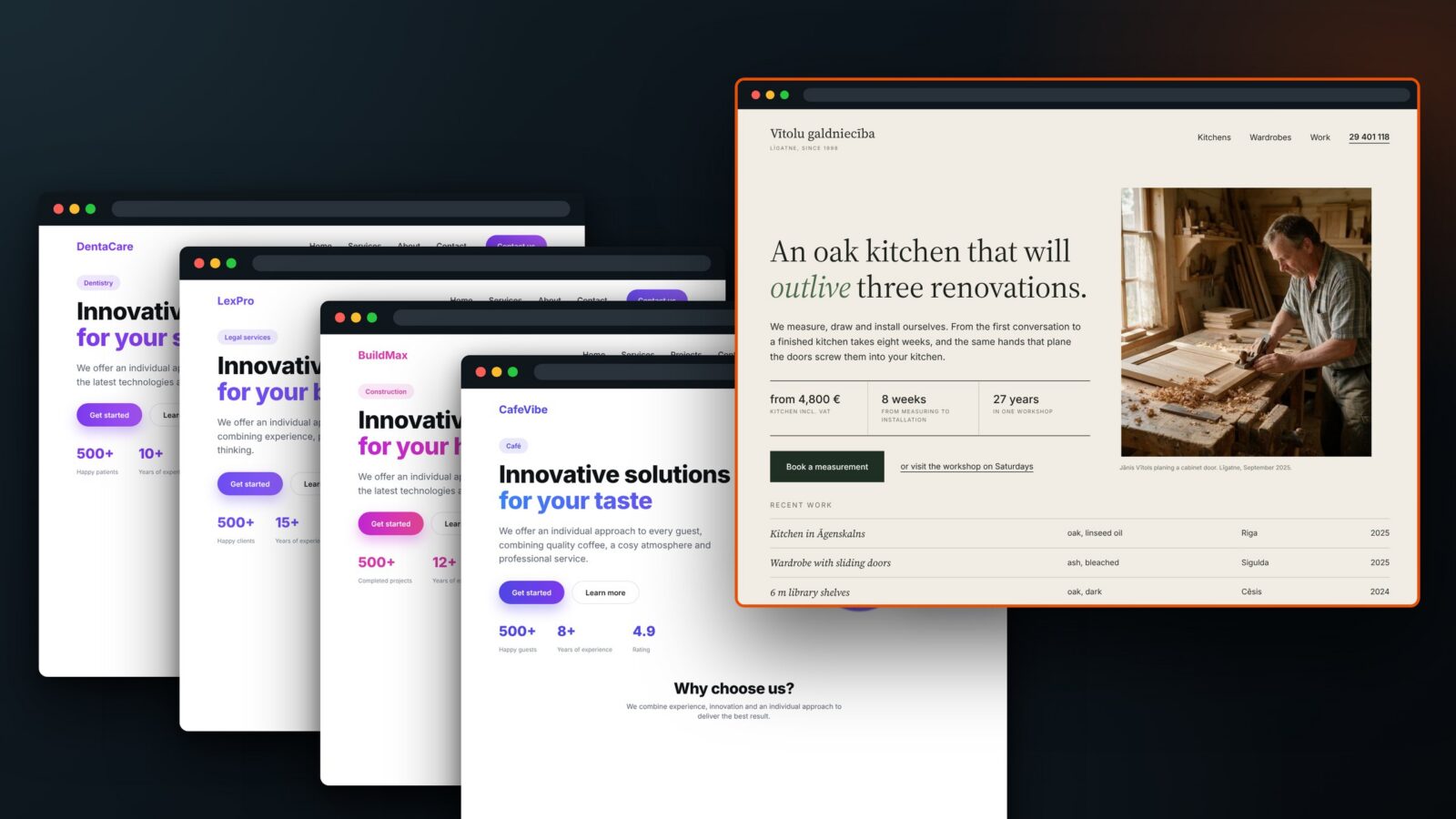
We built the four pages below in one afternoon. A dentist, a law firm, a construction company and a café. For each one we changed the name, the colour tint and six words in the headline. Everything else is the same template, and that is what a large share of new websites look like right now. The phenomenon has a name: AI slop.
What AI slop is
AI slop is content produced by artificial intelligence without human decisions: texts, images or entire websites that look finished but say nothing about the specific business. With websites it happens when someone gives a tool one sentence (“make a site for a dentist”) and publishes whatever comes back.
Slop does not come from using AI. It comes from nobody making the decisions: what the page is for, who it is for, how this company differs from the three others on the same street. A model cannot answer those questions, so it inserts the average answer, the one that fits everyone and no one. That is why all these pages look the same: they are the same average answer.
Four pages, one template
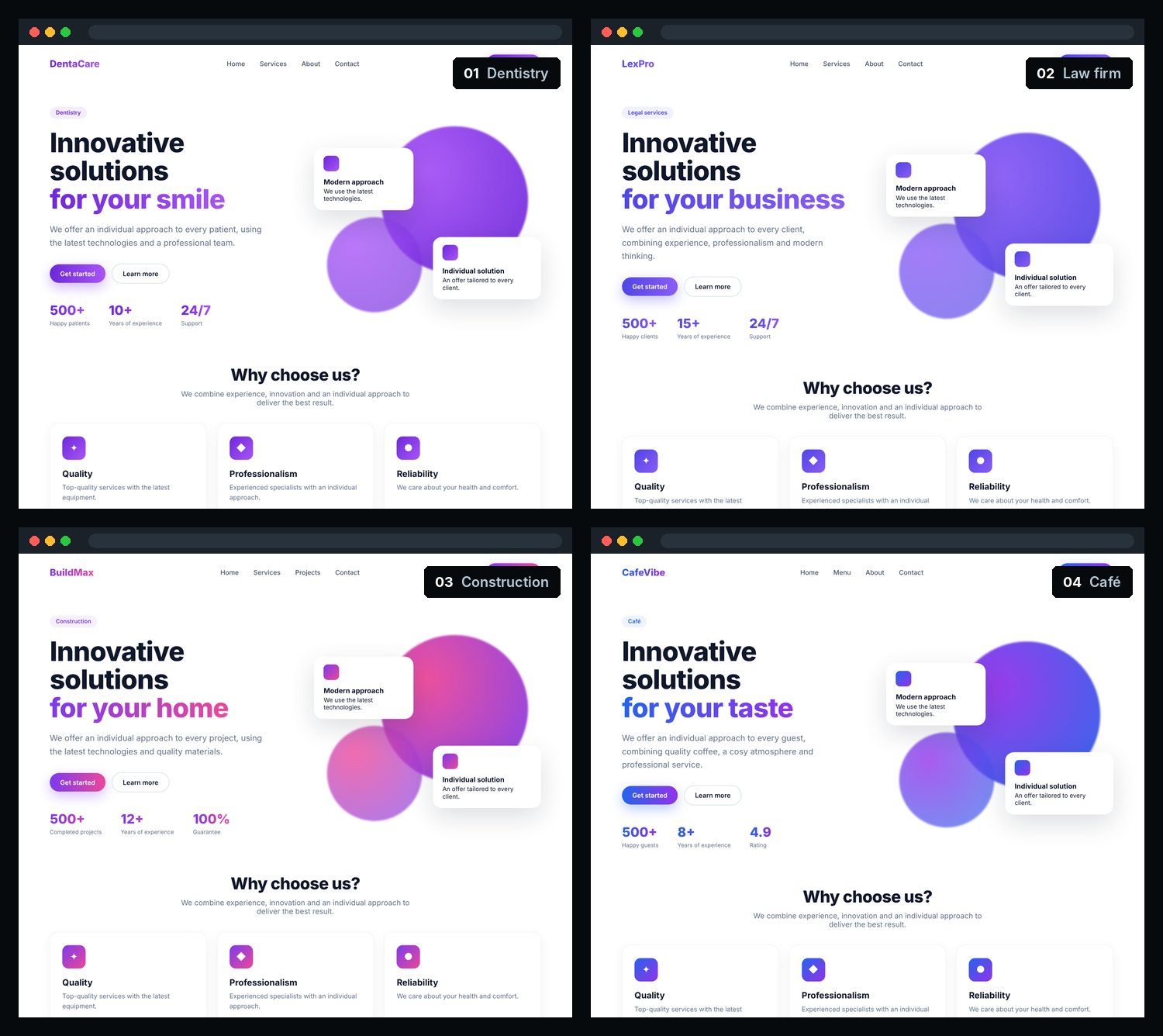
Look at the navigation, the headline, the two buttons, the three numbers and the three cards. On all four pages they sit in exactly the same place. The dentist promises “innovative solutions for your smile”, the café promises the same solutions for your taste. Everyone has 500+ happy clients, everyone has an “individual approach”, and nobody says what a visit costs, where the office is or why you should come here rather than next door.
These four pages do not belong to real companies. We built them ourselves to show the pattern, not to embarrass anyone. Open five sites launched in your industry in the past year and you will recognise at least a couple of them from the first screen.
How to spot AI slop in 10 seconds
- A headline you could move to any other industry without changing a word (“Innovative solutions for your business”)
- A purple or blue gradient on the buttons, the logo and the numbers
- Three cards with an icon in a rounded square: quality, professionalism, reliability
- Numbers with no source: 500+ clients, 10+ years of experience, 24/7 support
- A “Why choose us?” section whose answer does not answer
- No address, price, lead time or person’s name anywhere on the first screen
- Images that are not from this company: bubbles, abstract shapes or generated people with teeth that are too white
- Text with not a single sentence that only this company could have written
One sign on its own means nothing. A gradient is not a crime, and cards are sometimes the easiest way to show three services. When five signs match, the page was almost certainly made without a single decision.
The fifth page
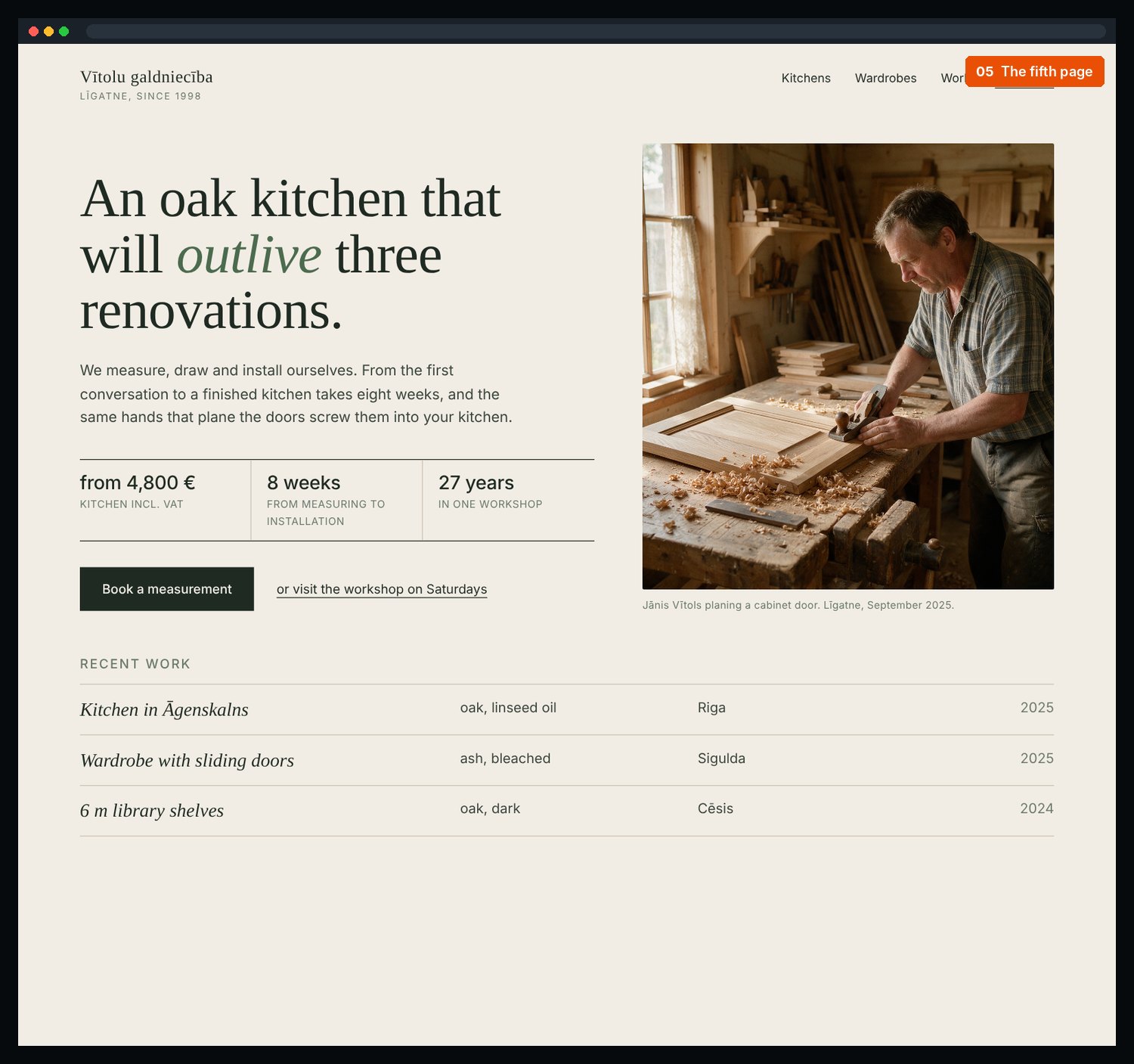
We made this page with the same tools as the previous four. There is only one difference: before generating anything, we answered the questions a model cannot answer. What this joiner does differently: he measures, draws and installs himself. What a kitchen costs: from 4,800 €. How long you wait: eight weeks. Where to find him: in Līgatne, at the workshop on Saturdays. The headline promises one concrete thing you can check: a kitchen that will outlive three renovations.
There is not a single gradient on the page, not one card with an icon and no “Why choose us?” section. Instead there are three numbers with a label and a list of recent work with places and years. That is enough for a person to believe it and call. Vītolu galdniecība is a made-up company, but every fact on the page is the kind of fact you would ask a real joiner in the first conversation.
Why it costs money, not just looks bad
The visitor cannot tell the difference and leaves
A buyer who opens three dentist sites with the same structure and the same promises chooses by price, or by whichever tab was open last. A page that does not differ does not compete. It only enters the lottery.
Google understands the content is average
Since March 2024, Google’s spam policies name scaled content abuse separately: content generated at volume without added value for the reader. A page whose text fits any company in the industry is exactly that kind of content to a search engine. It may be indexed, but it does not reach the first page, because it answers no specific question better than anyone else.
AI assistants do not recommend pages without facts
When a person asks ChatGPT or Gemini which dentist to choose in Riga, the assistant looks for pages with specific information: an address, prices, a list of services, the dentists’ names. A page with “innovative solutions for your smile” gives it nothing to quote. It is not an answer, so the assistant does not repeat it. We wrote about how this works and what to do about it separately: GEO 2026: why ChatGPT recommends your competitor, not you.
How we work
There is a lot of AI in our process. But it comes in after the decisions, not instead of them. We will not describe everything, because part of it is 17 years of work that clients pay us for. The principles, though, are simple.
- A conversation before the tool
- The first hour of any project is a conversation with the client, with the laptop closed: what they do differently, which client is their best one, what that client asks before buying. No model knows these answers, and without them there is nothing to generate.
- A human sets the structure
- The site map, the order of sections and what goes on the first screen are decided by a designer in Figma before the first line of code. AI offers variants, it does not choose.
- Text starts with facts
- Every section starts with a number, a place, a lead time or a name that can be checked. When a fact is missing we ask the client, we do not fill the gap with a “professional approach”.
- AI does the work that has one right answer
- Repeatable code blocks, field definitions, structured data, checklists, alt texts. Where the result is either right or wrong, a model is faster and more careful than a person in their eighth hour of work.
- The last reader is a human
- Before publishing, every page is read by a person who did not write it. If a sentence would fit any other company, it gets rewritten.
There is a separate article on where we let AI in and where we keep it out: How we use AI in development and where we keep it out.
What to do if your site looks like one of the four
You do not have to throw everything away. Most of the time the structure is usable; what has to change is what was put into it.
- Put one sentence on the first screen that only your company can say
- Replace “500+ clients” with three projects that have names, places and years
- Add a price, or at least what it starts from
- Remove the “Why choose us?” section and answer the same question with facts in the other sections
- Replace generated images with photos from your own business, even ones taken on a phone
- Test every sentence with one question: would it fit on a competitor’s site too?
If you would like someone from outside to look at the site, a website improvement audit starts with exactly this list. Send us the address and we will reply with an overview of what to change first.
Frequently asked questions
Is a website made with AI a bad website?
No. A bad website is one made without decisions. With AI you can build slop and you can build a very good site. The difference is the person who answered beforehand what the page is for and how the company differs from its competitors.
How do I check whether my site is AI slop?
Go through the eight signs in this article. If five or more match, neither a visitor nor a search engine can tell your site from your competitors’. A second test: imagine your headline on a competitor’s site. If it fits there, it is not your headline.
Does Google penalise AI-written content?
Google judges whether content is useful to the reader, not how it was made. Pages generated at volume with no new information get shown less. Text that a person has checked and filled with facts does not have this problem.
How much does it cost to fix a site that was made as slop?
Often you do not have to redo everything. A website improvement starts with an audit, after which you get a list of what to change and an estimate. Replacing the first screen, the texts and the images costs less than a new site. Simple new sites start from 600 € + VAT.
Does dizainsweb use AI itself?
Yes, in every project: for research, routine code, checks and first drafts of text. The structure, the design, the facts and the final text are decided and signed off by a person.