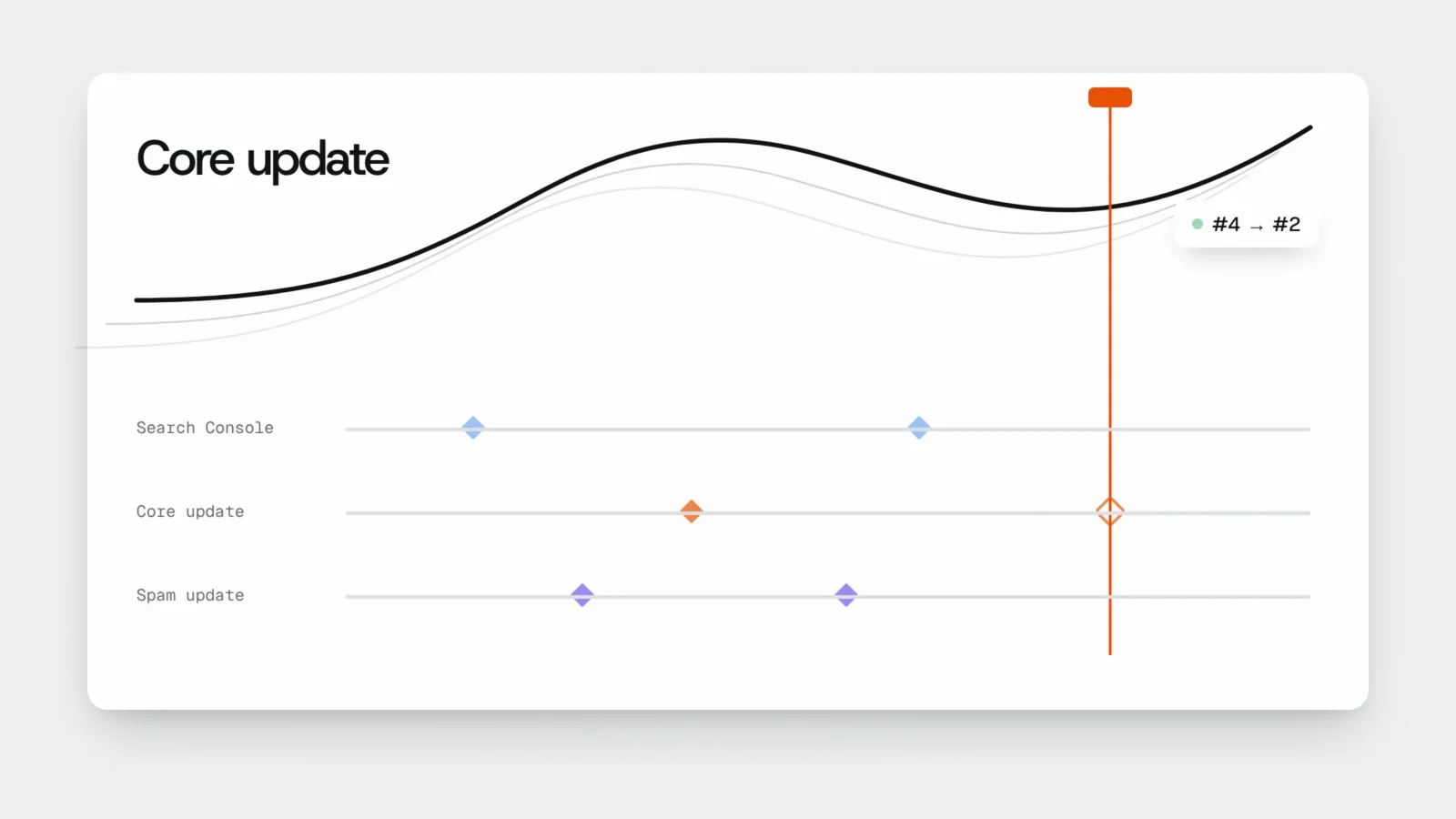
Google finished its last broad core update on 2 June 2026. Since then there have only been spam updates, and the latest one ran for almost two weeks, until 8 October. SEO consultant Dan Taylor’s prediction model puts the chance of the next big update within 30 days of 13 October at 96.8%, most likely between late October and mid-November. He expects it to go after scaled AI content and invented authors. Google has confirmed nothing, so this is a forecast. But it points the same way as everything Google has written into its policies this year, so it makes sense to check your site now, while nothing has dropped yet. We will update this article as soon as Google announces the update.
Latest on the update
We log changes here. The newest entry is at the top.
- 29.10.2026
- First version of the article. Google has not announced a core update yet. The latest entry on the Google Search Status Dashboard is the September spam update, which finished on 8 October.
What is known and what is only a forecast
Facts from the Google Search Status Dashboard for 2026:
- March: a spam update (24-25 March) and a core update (27 March to 8 April);
- May: a core update (21 May to 2 June);
- June and August: short spam updates of 2-3 days each;
- September: a spam update from 24 September to 8 October, the longest this year.
Google usually runs three or four core updates a year. There were three in 2025 and so far two in 2026, which is why Taylor thinks the next one is overdue. His model is built on 25 years of update history and on volatility signals in search results, but it is his own model and its accuracy has not been published. The update could just as well come in December or next year.
The exact date matters less than the direction. Every update this year has pushed the same way, and the next one will most likely continue it.
Why everyone is talking about Panda
Panda was Google’s February 2011 update that judged the quality of a whole site, not just individual pages. If a site had lots of empty pages, the good ones suffered too. Taylor expects similar logic now: if a large part of a site is mass-generated, the whole site can lose rankings, not only the weak pages.
There is a basis for this. Google analyst Gary Illyes warned publicly this year that scaled content is becoming a bigger problem than link spam. Four spam updates in one year is more than in any year since 2021.
What Google penalises and what it does not
The most important point first: Google does not penalise text because AI helped write it. Google’s guidance on generative AI (updated on 1 October 2026) says AI can be useful for researching a topic and for adding structure to original content. The trouble starts when AI or other tools are used to churn out many pages that give the user nothing. Google calls this scaled content abuse.
Google’s spam policies give examples: many AI-generated pages with no added value, content stitched together from other sites, pages that make little sense to a reader but contain keywords, and multiple sites created to hide how much of this content there is.
One more requirement that small businesses often miss: Google asks you to check all AI content by hand before publishing, including titles, meta descriptions, structured data and image alt text. Those are exactly the things that are usually generated automatically and never read by anyone.
On business websites in Latvia and the Baltics we most often see three risky patterns:
- city pages where only the city name changes: “Window repair in Ogre”, “Window repair in Tukums”, with the same text;
- a blog that gained 40 articles on general topics in a month, without a single example or number of its own;
- an author with an AI-generated photo and “15 years of experience” who has never worked at the company.
An example: two window companies
To make it concrete, picture two companies that both install PVC windows in the Zemgale region of Latvia. This kind of situation is very common.
In spring the first one used an AI tool to create 85 pages in one weekend: “PVC windows in Jelgava”, “PVC windows in Bauska”, “PVC windows in Dobele” and so on, plus 30 blog posts on how to choose windows. The texts are grammatically correct, but every page has the same content with a different city name. Traffic grew over the summer because Google showed these pages at first. Search Console now shows that 70 of the 85 city pages have had no clicks at all in the last three months.
The second one has 14 pages. The service page has a price from €290 for a standard window with installation, photos from real jobs, warranty terms and installation lead time. The blog has 8 posts, for example on why new windows fog up in winter and when that points to an installation fault. AI helped prepare the posts, but the facts and photos came from the installer, and every post was read before publishing by someone who installs windows himself.
If the next update really does judge the site as a whole, the first company’s risk is not limited to its 85 city pages. They can drag down the homepage and the main service page, which have ranked well so far. The second company has nothing to hide, and sites like it usually gain from quality updates.
That does not mean the first company should delete everything. More on that below.
A 30-minute check
You can do this yourself with Google Search Console and a browser.
- In Search Console open Performance → Pages and select the last 3 months. Sort by clicks, lowest first. Pages with 0 clicks and very few impressions are the first to review.
- Open three random service or city pages side by side. If the first two paragraphs differ by only one word, that is a problem.
- Pick a sentence from your homepage and ask whether it could go on a competitor’s site without changing a word. If it could, it says nothing about you.
- Check your authors. Is everyone who signs an article a real person who works at the company? If the photo is generated and the name invented, sign the post with the company name instead.
- Look at the meta descriptions of at least ten pages (right-click in the browser, “View page source”, search for
description). Do they match the page? Are many of them identical? - Check facts in older posts: prices, laws, software versions, the year in the title. “Best solutions in 2024” looks abandoned at the end of 2026.
- Count how many posts you published in the last six months and how many contain something only you know: your own figure, a photo, a customer question, a mistake you have seen on the job.
What to do with weak pages
Mass deletion in a panic is not the best route. Each page has three options.
Improve
If a page has impressions and the topic matters to customers, add what nobody else has: a price, a lead time, your own photo, an example, an answer to the question customers actually ask on the phone.
Merge
Instead of ten city pages you can have one page, “PVC windows in Zemgale”, with the service area, jobs in different towns and a single price table. Redirect the old addresses to the new page with a 301 so links and impressions are not lost.
Remove
Pages with no clicks, no external links and no value to customers can be deleted or excluded from indexing (noindex). If a page has external links, redirect it to the closest topic instead.
If you really need city pages, for example because you have an office or a crew in each town, give each page something of its own: an address, jobs done in that town, reviews from customers there.
If the update starts
Google announces core updates on the Search Status Dashboard, and they usually take about two weeks. Both core updates this year took 12 days.
- Do not change the site in bulk while the update is rolling out. Rankings jump around during this time, and one day of data tells you nothing.
- Google recommends waiting at least a full week after the update finishes, then comparing that week with the week before it started.
- Use Search Console, not rank trackers. Since mid-September Google has been serving shuffled results to part of the automated requests. Ahrefs estimates this affects 5-20% of results depending on the data supplier, so tools can show drops that are not real.
- If the drop is small, no big changes are needed. If it is large and lasting, assess the site as a whole, not just one page.
Recovery is not quick. Google says its systems can take several months to notice improvements, and sometimes the result only shows with the next core update. So fixing the site now costs less than fixing it in December.
How we write with AI ourselves
We use AI every day, including for this article: it helped find and compare sources. But a person chose the topic, the example is based on what we see on Latvian business sites, and every fact was checked against the primary source listed at the end. That is what Google means by added value. We wrote about our process in How we use AI in development and where we keep it out, and about how AI content shows up in website design in AI slop: how to spot it in 10 seconds.
What to do this week
- Find pages in Search Console with no clicks in the last 3 months.
- Compare your city and service pages: does each have content of its own?
- Check that every article author is a real person.
- Fix outdated facts, prices and years in titles.
- For each weak page decide: improve, merge or remove.
- Write down your current clicks and impressions so you have something to compare with after the update.
Frequently asked questions
What is a Google core update?
A broad change to Google’s ranking systems that Google makes a few times a year and announces on the Google Search Status Dashboard. It is not a penalty for a specific page: Google re-assesses which pages answer a query best. There have been two in 2026, in March and May.
When is the next Google core update?
Google does not announce it in advance. Dan Taylor’s prediction model points to late October to mid-November 2026 as the most likely window, but that is a forecast, not information from Google. We will update this article as soon as Google announces the update.
Does Google penalise AI-written content?
Not in itself. Google acts against large numbers of pages produced to manipulate search results that give users nothing, whether AI or a person wrote them. Google recommends checking all AI content by hand before publishing, including titles, meta descriptions and alt text.
Are city pages against the rules?
No. The problem is pages where only the city name changes. If each city has its own content, such as an address, completed jobs and reviews from local customers, the pages are useful.
Should I delete old posts nobody reads?
Not all at once. First check whether a post has external links and impressions in Search Console. Improve the ones with potential, merge similar ones with a 301 redirect, and remove only the rest.
How long does it take for rankings to recover?
Some improvements can show within a few days, but Google says its systems may need several months. Sometimes the change only appears after the next core update.
Want someone to look at your site?
Send us your site address. We will check it for scaled content, duplicate pages and other things that could hurt in the next update, and tell you where to start. You can see how we work on the SEO and GEO and website improvement pages. To get in touch, fill in the form or call +371 25 640 062.
Sources
- Google Search Status Dashboard: ranking update history
- Google: spam policies (scaled content abuse)
- Google: using generative AI content
- Google: core updates and what to do after them
- Search Engine Journal: Dan Taylor’s Panda-style update forecast
- Search Engine Roundtable: September spam update complete
- Search Engine Roundtable: Gary Illyes on scaled content
- PPC Land: Ahrefs on shuffled Google results in SEO tools