

You can choose an office chair online. Hardly anyone wants to buy one without sitting in it first. That was one of the first things the THOMSON Furniture team told us, and it shaped everything that followed: the website should not pretend to be an online shop. Its job is to bring a person to a conversation, a quote and the showroom on Katlakalna Street in Riga.
The situation
THOMSON Furniture has been fitting out offices and public spaces since 2007. The company represents more than 50 European manufacturers, including Narbutas, Haworth, Noti and Framery, and handles the whole journey: measurements, design concept, ordering from the factory, delivery, installation and warranty service. The team is around 30 people, and the client list ranges from start-ups to banks, clinics and municipalities.
The previous website no longer showed the size of the range or how the company works. It needed a new website where the catalogue, completed projects and the work process tell one story, and which Google understands well too.
Three people at one table
Office furniture is rarely chosen by one person. Usually three people are involved in the decision, and each of them looks for something different on the website. We built the structure around their questions.
The office manager or HR specialist
Wants to know whether a chair will suit someone who spends eight hours at a computer. They need clear categories, good product photos and a manufacturer name they can compare with other offers.
The procurement specialist
State and municipal institutions in Latvia often buy furniture through the Electronic Procurement System (EIS). That is why the catalogue has a separate EIS section with the products available there, so a buyer does not have to call to find out.
The architect or interior designer
Often the one who recommends a furniture supplier to the client. An architect needs to see that the company can deliver another author’s design, and to get 3D files and material samples quickly. The about page has a separate invitation for designers and architects with exactly this offer.
What we built
- Catalogue
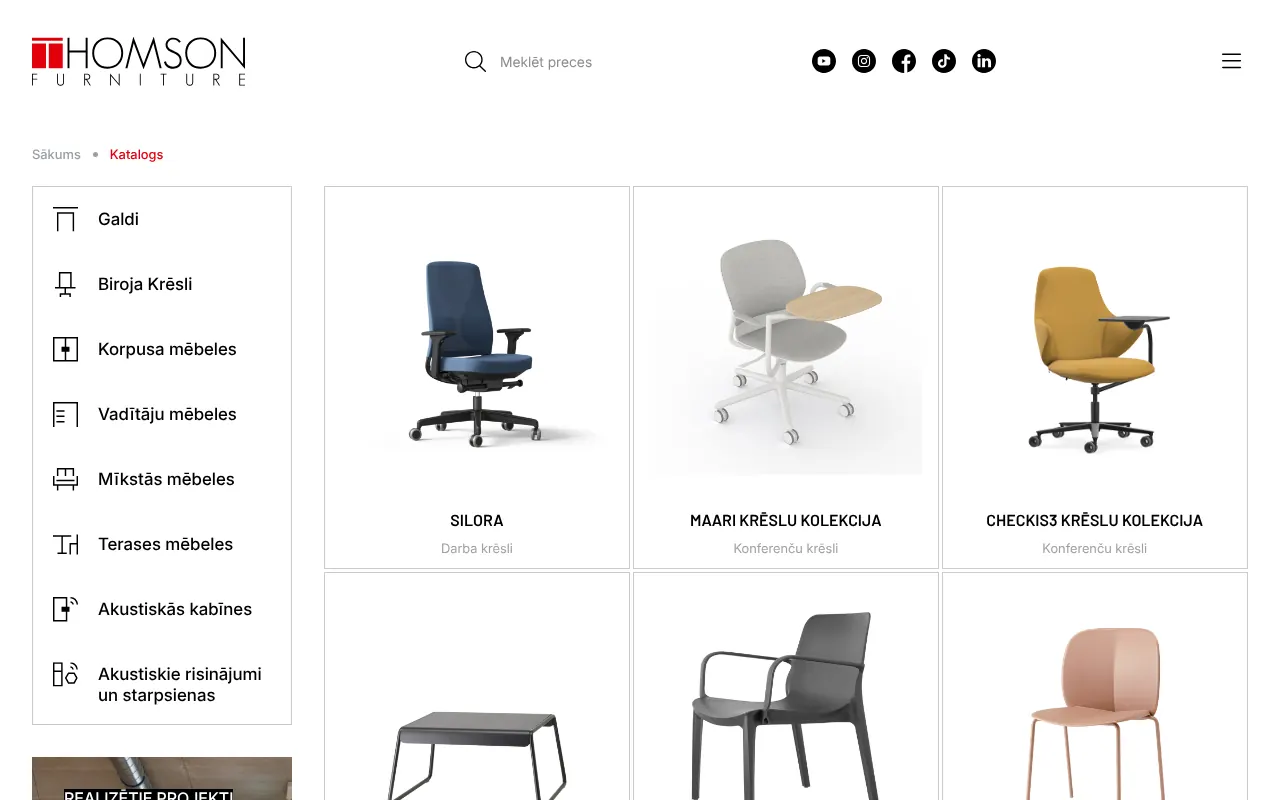
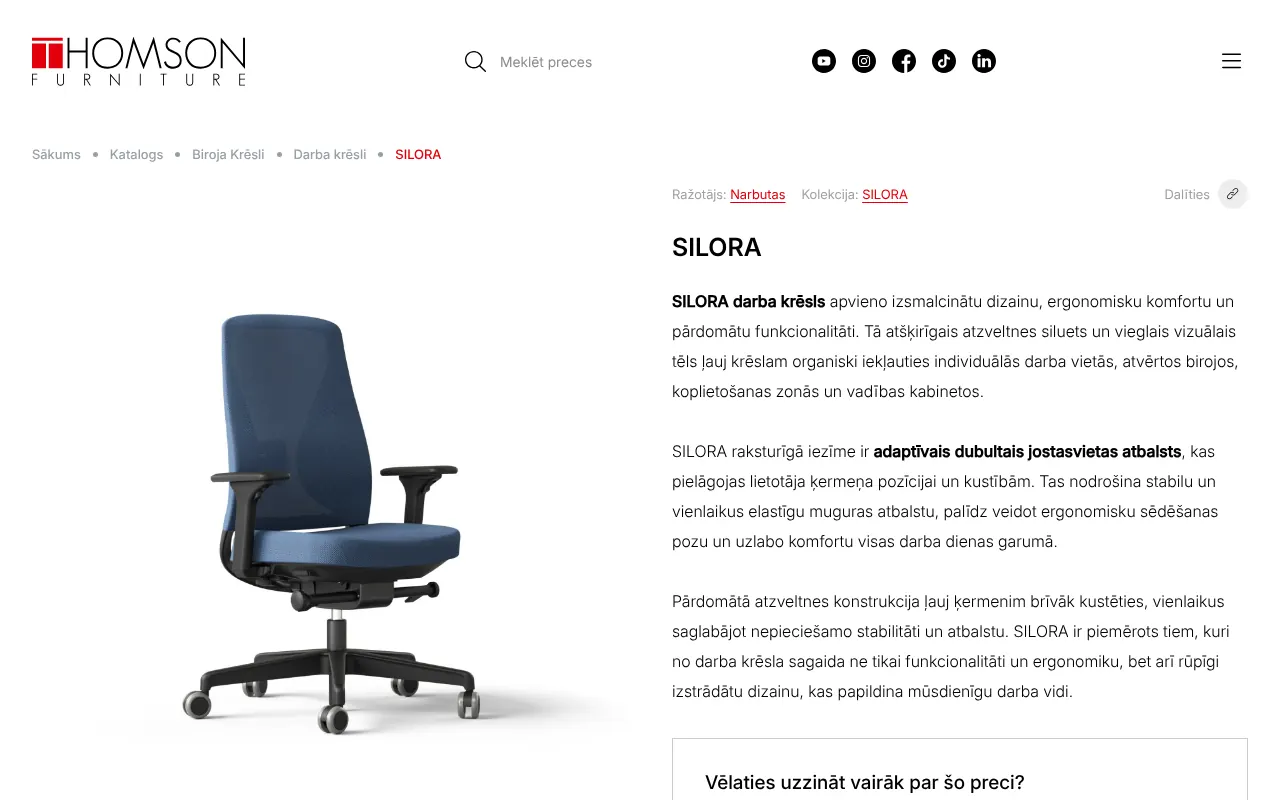
- Nine sections, from desks and chairs to acoustic pods and partitions. Every product has its own page with the manufacturer, collection, description and related products. More than 200 product pages mean more than 200 chances to be found by the name of a specific model.
- Enquiry
- A shopping cart with prices would work badly for office furniture, because the price depends on finishes, quantity and installation. So every product page has a “Contact us” button and a clear promise to reply within one working day.
- Search
- The search in the header shows products after just three typed characters. Someone who arrives with a model name from a colleague or an architect finds it without browsing the categories.
- Projects
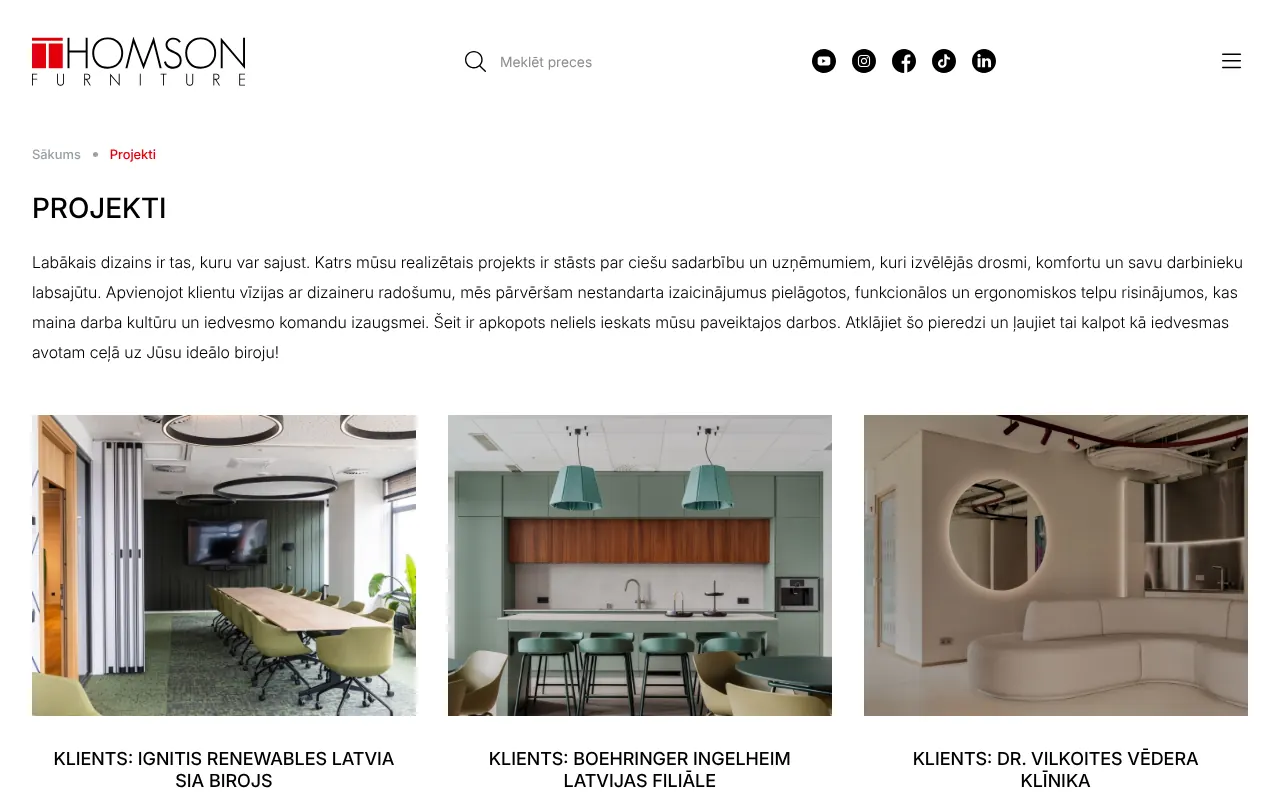
- 38 completed project pages with photos and credits: the interior designer, the furniture project manager and the photographer. It is fair to colleagues and works as a referral, because an architect sees their name next to a job well done.
- Process
- Five steps from vision to warranty on the homepage. For a company furnishing an office for the first time, they answer the question of what exactly it is buying before the conversation ever reaches price.
- Trust
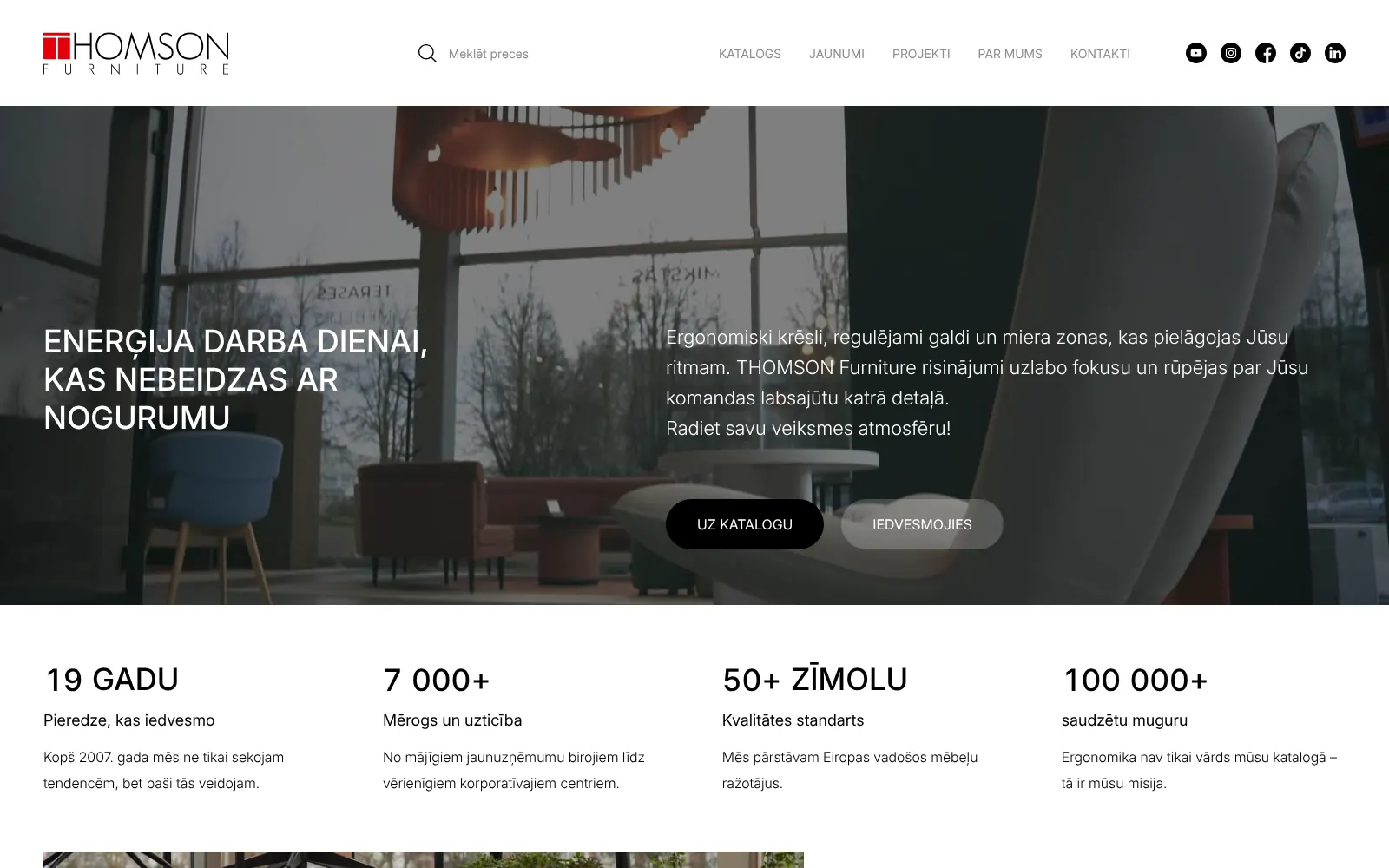
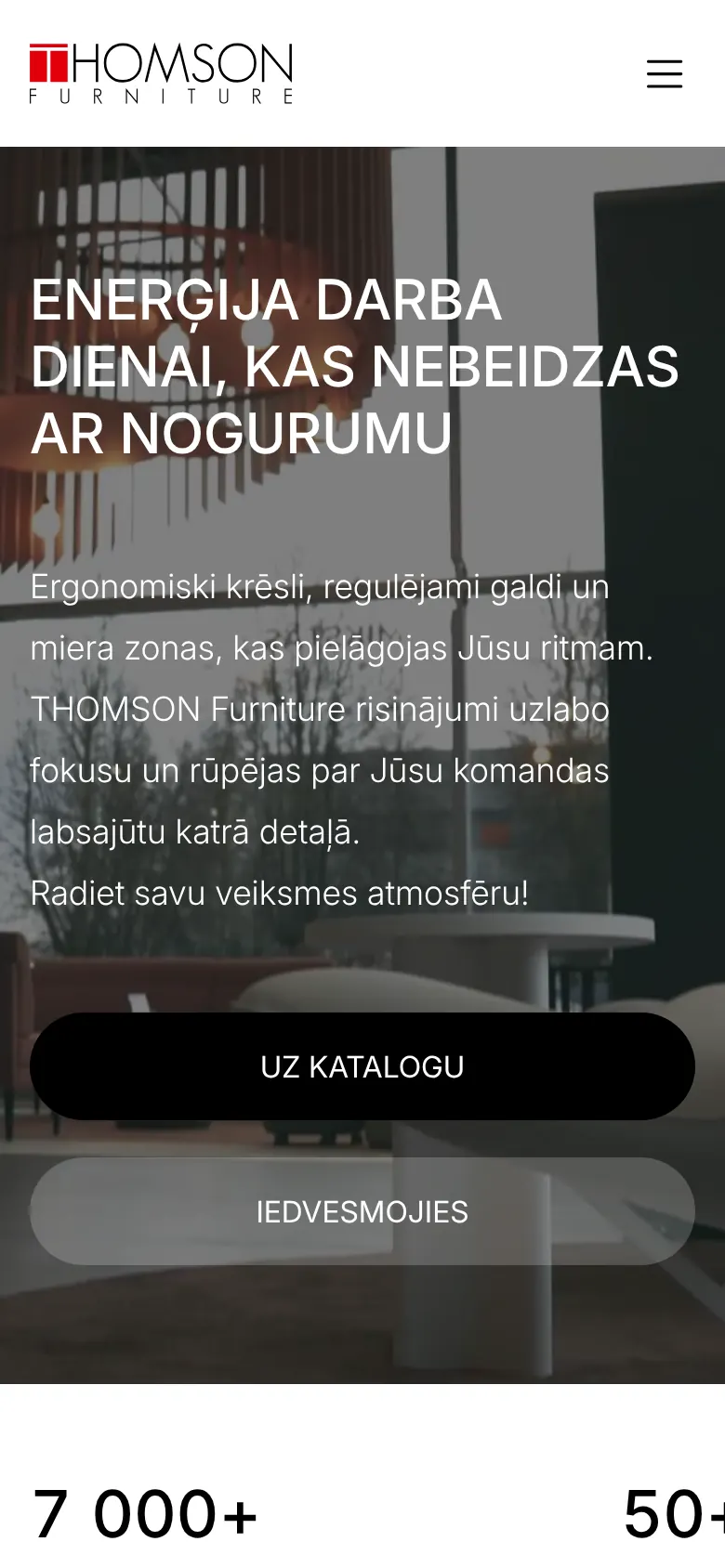
- The site opens with a video from the showroom, followed by the numbers: 19 years in the industry and more than 50 brands. Then the manufacturer logos and client logos, from airBaltic to the City of Riga.
What we learned
Not every website with products needs a cart
The temptation to turn everything that has products into an online shop is strong. But when a typical order is a whole office with installation, a cart raises more questions than it answers. An enquiry with a fast reply works better here, because the conversation is part of the product.
A product page is also an SEO page
People often search not for “office chair” but for a specific model they saw at a colleague’s office or in an architect’s project. If each model has its own address with the manufacturer and collection name, Google and AI assistants can point to it. A single shared category with thirty photos cannot.
The project gallery is a sales tool
A new client decides most easily when they see a similar company in an office that is already fitted out. That is why the projects have not just photos but context: who the client was, who designed it, who managed the work. It answers the question “can they handle our scale?” without a salesperson.
The showroom is the destination
The contacts page has the address, free parking and opening hours, but the call to action is one: come and try it. The website has done its job when a person is sitting in the chair, not when they have put it in a cart.
How it works day to day
The website is managed by the THOMSON Furniture team itself. A new product is added by choosing its category, manufacturer and collection, and it appears in the catalogue, in search and among related products. A new project is added with photos and credits. In the news section the team writes about new collections and partners, so the site does not age between big updates.
We chose the platform based on the size of the catalogue: hundreds of product pages with their own fields is a task where WordPress with a custom theme gives the most freedom. Why we now recommend WordPress more often is covered in our comparison with Wix Studio.
What you can repeat
- Find out who actually buys from you: usually several people with different questions
- A separate page for every product, with the manufacturer and model in the title
- An enquiry right on the product page with a clear reply time
- Projects with context and credits, not just a photo gallery
- A separate section for public buyers if you work with procurement systems
- Showroom address, parking and opening hours visible without searching
Check for yourself
Everything you've read about is live. Open thomsonfurniture.lv and explore these sections yourself.
Frequently asked questions
Does a furniture dealer need an online shop with prices?
Not always. If the price depends on finishes, quantity and installation, a catalogue with an enquiry on every product page works better. An online shop makes sense when you sell standard products with a fixed price and delivery.
How much does a website like this cost?
A simple website starts from €600 + VAT. A catalogue with hundreds of products, a projects section and a custom theme is a company-level project, and its price is based on the specification. Tell us about your range and we will reply with a sitemap and a quote.
Can the company add products and projects itself?
Yes. The website is built so the team adds a new product, category or project on its own, without a developer.
Why are there no prices in the catalogue?
The price of office furniture depends on finishes, fabric, quantity and installation. An exact quote after a conversation is more honest than a price in a cart that changes later.