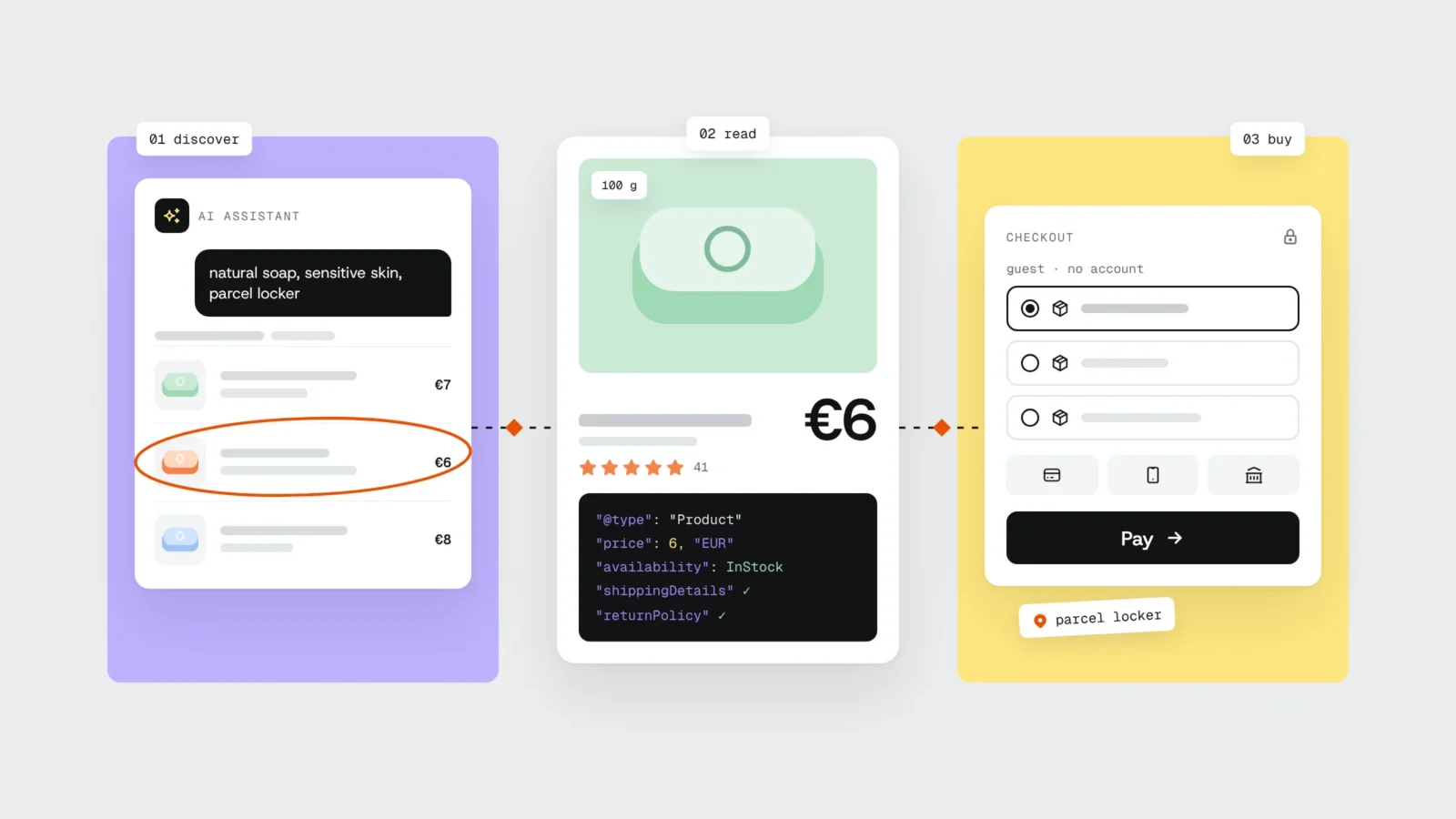
In 2026, AI assistants already help people choose products, but the purchase itself still mostly happens in the online store. In March 2026 OpenAI dropped buying directly inside a ChatGPT conversation (Instant Checkout) and now sends shoppers to the merchant’s own checkout, while agent checkout from Google, Microsoft and Meta works only in the US. None of these buying tools are available in Latvia or the rest of the Baltics yet. ChatGPT, Gemini and Perplexity, however, already answer “what should I buy” questions and recommend stores based on what they read on their pages. The safe planning assumption is this: more and more purchases will start inside an AI assistant, and the store that wins is the one whose product pages a machine can read and whose checkout is easy for the person the AI sends over. In practice that means product names with specifications, price, availability, shipping and returns in structured data, a separate shipping page, reviews, and a checkout with guest purchase and parcel lockers. This article was written on 13 November 2026.
Latest on AI shopping
- 15.10.2026
- Google launches Universal Cart: one cart for products from several stores in Google Search and Gemini, with checkout powered by UCP. US only.
- 08.09.2026
- Meta launches Muse, a personal AI agent that can complete a purchase with Stripe Link once the shopper approves. US first.
- 02.07.2026
- Visa announces the first agent purchases at European online stores: 31 banks, four named merchants, every transaction approved by the cardholder. Latvia’s largest banks are not on the list.
- 24.03.2026
- OpenAI changes shopping in ChatGPT: instead of Instant Checkout, shoppers complete the purchase in the merchant’s checkout, and ACP now serves product discovery.
- 11.01.2026
- Google, together with Shopify, Etsy, Wayfair, Target and Walmart, publishes the open Universal Commerce Protocol (UCP). Checkout in AI Mode and Gemini is aimed at US retailers.
- 29.09.2025
- OpenAI and Stripe launch Instant Checkout and the Agentic Commerce Protocol (ACP): US users can buy Etsy items directly in a ChatGPT conversation.
What agentic commerce is and what works today
Agentic commerce means purchases where an AI assistant searches for a product, compares offers and handles part or all of the purchase on the shopper’s behalf. In 2026 it helps to separate three levels:
- AI helps choose. The shopper asks ChatGPT, Gemini or Perplexity what to buy, gets a few recommendations with links and buys in the store. This works everywhere, including Latvia and in Latvian.
- AI prepares the cart. The assistant puts items in a cart and the shopper only confirms and pays. That is how Google Universal Cart and Microsoft Copilot Checkout work, both US only.
- AI buys on its own. The shopper sets rules (“buy it when the price drops below €80”) and the agent pays without them being present. Banks and card networks are testing this, but there is no mass-market service in any country yet.
The news mostly covers level three, while for a Latvian online store today the customers come from level one.
Why ChatGPT gave up on buying inside the chat
On 29 September 2025 OpenAI launched “Buy it in ChatGPT”: US users could buy a single item from US Etsy sellers without leaving the conversation, with Shopify stores promised soon. Under the hood it ran on the Agentic Commerce Protocol (ACP), built by OpenAI with Stripe: ChatGPT passes the order to the merchant’s system, and the merchant stays the seller, processes the payment and ships the product.
Six months later OpenAI changed course. On 24 March 2026 the company said the first version did not give merchants and shoppers the flexibility they needed, so merchants can now use their own checkout while OpenAI focuses on product discovery. Shopify shoppers complete the purchase in the store’s checkout inside ChatGPT’s in-app browser, and large retailers can build their own app within ChatGPT. Walmart executive Daniel Danker said in March that the roughly 200,000 products Walmart offered through Instant Checkout sold three times less often inside the chat than when shoppers clicked through to Walmart’s site.
In our view this is the most important e-commerce fact of 2026. People are happy to let AI recommend, but they want to pay somewhere they know: with their own account, their usual payment method and clear return terms.
ACP, UCP, AP2 and the card networks
Several open protocols have emerged around agentic commerce. A small store does not need to implement them itself, but it is worth knowing what they are when you read about them or get a sales pitch.
- Agentic Commerce Protocol (ACP), OpenAI and Stripe. Since March 2026 ChatGPT uses it to receive store catalogues, prices and promotions. OpenAI’s merchant page says shopping in ChatGPT is currently live for US users and will expand to more regions over time.
- Universal Commerce Protocol (UCP), Google with Shopify, Etsy, Wayfair, Target and Walmart, published on 11 January 2026. It lets an agent find a product, add it to a cart and pay with Google Pay. Google’s Merchant Center help says the integration is gradually rolling out in the US, with Australia and Canada next year.
- Agent Payments Protocol (AP2), Google and more than 60 partners, September 2025. It addresses how to prove the shopper really authorised the agent: the purchase intent and the exact cart with its price are signed as digital “mandates”.
- Visa Intelligent Commerce and Mastercard Agent Pay. Card network systems that let banks and merchants recognise a verified agent. On 2 March 2026 Santander and Mastercard completed Europe’s first end-to-end agent payment in a controlled environment, and in July Visa announced agent purchases at European stores with 31 banks. Swedbank, SEB, Citadele and Luminor are not on that list.
All these protocols share one need: the agent requires precise, machine-readable data on the product, price, stock, shipping and returns. You can put that data in order in your store now, and it already works in regular Google Search.
What is available in Latvia and the Baltics
As of November 2026, a shopper in Latvia cannot buy inside AI on any of the major platforms. Checkout in Google AI Mode and Gemini, Universal Cart, Microsoft Copilot Checkout and Meta Muse work in the US, and so does ChatGPT’s product feed programme. Everything that happens before the purchase does work here:
- ChatGPT, Gemini and Perplexity answer “where can I buy” questions in Latvian, Lithuanian, Estonian and Russian, search the web and recommend specific stores with links;
- Google AI Mode has been available in Latvian since February 2026 and builds its answers from the Google index;
- a shopper sent by AI usually lands straight on a product page, not the homepage.
Adobe’s US data shows where this is heading. In Q1 2026 AI-referred traffic to retail sites grew by 393%, and in March these visitors converted 42% better than other traffic. In March 2025 they converted 38% worse. For the holiday season Adobe forecasts AI traffic growth of 130%. The percentages are large partly because the starting point was small, but the direction is clear: AI sends fewer people than Google, and those who arrive already know what they want.
How to see visitors from AI assistants separately in Google Analytics 4 is covered in our article Fewer clicks: what a small business should measure in the age of AI search.
What a machine needs to read on a product page
An AI assistant comparing products looks for what a careful shopper looks for: what it is, the specifications, the total price with shipping, whether it is in stock, when it will arrive and whether it can be returned. The difference is that a machine often cannot read a label shown only in a photo, or a price that appears only after you choose a size. In Adobe’s AI content visibility scoring (April 2026), product pages were the least machine-readable page type: an average of 66 out of 100, against 82 for returns pages.
Product name and description
Put in the name what people type in their question: the product type, the key feature and the size. “Oak table 160 × 90 cm, oiled” can be compared by AI; “Table Nora” cannot. Write the specifications in text or a table: dimensions, weight, material, ingredients, colour, compatibility, what is included, country of manufacture. If a product page has three sentences about feelings and not a single number, the assistant will pick a competitor whose page has numbers. We explained how to write quotable answers for service pages in GEO 2026: why ChatGPT recommends your competitor, and the same principle applies to product pages.
Product and Offer structured data
Structured data is a description embedded in the page code (JSON-LD) that tells a machine the product name, price and the rest without guessing. Google uses it in product results, and it is the same vocabulary the agent protocols work with. Check these fields on a product page:
Product: name, image, description, brand, sku and, if you have one, gtin (barcode);Offer: price, priceCurrency (EUR), availability (InStock, OutOfStock, PreOrder) and url. The price must match what the shopper sees on the page;shippingDetails: shipping cost and time in Latvia, for example parcel locker €2.99 and 1-3 business days;hasMerchantReturnPolicy: the return period and process. Google recommends describing your return policy once at the Organization level and only exceptions at product level;aggregateRatingandreviewonly if the reviews are visible on the page itself.
WooCommerce and Shopify themes usually output basic Product data with price and availability. Shipping and returns fields are often missing, and sometimes an SEO plugin switches off WooCommerce’s markup without adding its own. Test 3-5 products in Google’s Rich Results Test and check the Merchant listings report in Search Console.
Shipping, returns and contacts on separate pages
Shipping and returns need their own page with a clear URL, such as /shipping-and-returns/, stating in text: which parcel lockers and couriers, how much, how long, the threshold for free shipping, which countries you ship to, how many days the right of withdrawal lasts and how to return an item. If this information only appears at checkout, AI does not see it, because crawlers never reach the checkout. Company details, address and phone number belong on the contact page as text, not only in an image.
Reviews
AI uses reviews on a product page as evidence that the product exists and buyers are satisfied. Ask for them in an automatic email 7-10 days after delivery and show them on the page as text. Do not buy reviews or filter out the negative ones: Google’s policies and EU unfair commercial practices rules both prohibit it. How reviews affect Google Search and AI answers is covered in Google reviews in 2026.
What the person AI sends to you needs
A visitor from ChatGPT or Gemini arrives with a decision already made and one question: can I really buy it here, right now? They know nothing about your store, so within the first seconds on a product page they need to see the price, whether it is in stock, the shipping cost and time, and an “Add to cart” button.
- Guest checkout. Registration before purchase is a hurdle a new shopper does not understand. You can offer an account after payment.
- Parcel lockers at checkout, searchable by city or street: Omniva, DPD, Venipak and Latvijas Pasts. In the Baltics, shoppers take this for granted.
- Payment by bank link, card, Apple Pay and Google Pay. The less a shopper has to type, the fewer purchases get lost on a phone.
- The total price before checkout: shipping visible on the product page or in the cart.
- A checkout that works with a keyboard and a screen reader. What the European Accessibility Act requires of an online store checkout is covered in European Accessibility Act: who it already applies to in Latvia.
WebMCP: when the agent fills in the form itself
The next step is agents that work in the browser: they open your page and use the search box, filters and forms. Chrome is testing WebMCP for this in an origin trial. With two HTML attributes (toolname and tooldescription) an ordinary form can be described as a tool an agent understands, for example “search products by size” or “request a custom order”. The specification is still changing, and we do not recommend adopting it in a store that is not ready to rebuild its forms every few months. Far more useful today are forms with proper label, type and autocomplete fields, because people, browsers and the next generation of agents all understand them. How WordPress 7.0 is preparing for AI tools is covered in WordPress 7.0 puts AI in core.
Example: a handmade soap store in Cēsis
Suppose a small soap workshop in Cēsis runs a WooCommerce store: 120 products, about 2,400 visits and 45 orders a month, an average basket of €24. The owner notices that customers increasingly say “I found you through ChatGPT”, yet nobody has found her store that way. She asks the question herself: “natural soap for sensitive skin with delivery to a parcel locker in Latvia”. ChatGPT names two other stores, Gemini one of the same and a third.
Why the AI recommended a competitor
Comparing her product page with the competitor’s, she finds four differences:
- Name and description. Her product is called “Forest Morning”, with three sentences about the scent and the workshop. The ingredients are only visible in a photo of the label. The competitor’s product: “Oat milk soap, fragrance-free, 100 g”, with ingredients in text and skin type and weight in a table.
- Structured data. An SEO plugin setting had switched off WooCommerce’s markup, so product pages only had Product with a name and an image. There was no price, currency or availability in the code.
- Shipping. The parcel locker price only appeared at checkout, and there was no separate shipping page. The competitor’s page said: “Omniva, DPD and Venipak parcel lockers, €2.99, 1-2 business days, free over €35”.
- Reviews. In two years the product pages had collected 9 reviews; the competitor had hundreds.
What the store fixed
- All 120 names got the product type, key feature and weight, for example “Goat milk soap with calendula, fragrance-free, 100 g”. The old name stayed in the description.
- Each product got a specifications table: weight, ingredients (the full INCI list from the label), skin type, scent or “fragrance-free”, packaging. The words “for sensitive skin” were kept only on the 14 products whose safety assessment supports the claim, because EU cosmetics claims require it (Regulation 655/2013).
- WooCommerce structured data was switched back on and extended with shippingDetails (Latvia, parcel locker €2.99, 1-3 business days) and an Organization-level return policy.
- A “Shipping and returns” page was created with lockers, prices, delivery times, the 14-day right of withdrawal and the exception: opened hygiene products cannot be returned (Article 16 of the EU Consumer Rights Directive).
- On day 8 after each order an email goes out with a link to review that specific product.
- A “Fragrance-free” category was created with a 120-word introduction on how the soaps are made and who they suit.
- At checkout the parcel locker choice was moved to the top, and Apple Pay and Google Pay were added. Guest checkout was already there.
What changed after 8 weeks
Once a month the owner asks 12 questions in ChatGPT, Gemini and Perplexity, 36 answers in total. Before the fixes the store appeared in none; after 8 weeks it appeared in 7, mostly for questions about fragrance-free and goat milk soap. Errors in the Search Console Merchant listings report dropped from 120 to 0. In the GA4 AI channel, sessions grew from 30 to 140 a month and orders from these visitors from 1 to 6 (52 orders a month in total, up from 45), with a conversion rate of 4.3% against the store average of 1.9%. Reviews grew from 9 to 41 in two months.
Six orders out of 52 is a small share. More importantly, the same fixes improved Google too: clicks to product pages rose by 18% because price and shipping started showing in product results. The store needed no product feeds or agent protocols, and when those reach Latvia its data will already be in order.
A 30-minute check
- Ask the AI. Put 5 questions a shopper would ask about your products to ChatGPT, Gemini and Perplexity, including location and delivery (“… with delivery to a parcel locker in Latvia”). Note which stores they name and which pages they cite.
- The competitor’s page. Open the recommended competitor’s product page and compare it with yours: name, specifications, price, shipping, reviews.
- Structured data. Test 3 products in the Rich Results Test: is there an Offer with price, currency and availability, shippingDetails and a return policy?
- Text without images. Open a product page, select all text (Ctrl+A) and paste it into a note. If the ingredients, dimensions or price are not there, a machine cannot see them.
- Shipping page. Is there a separate page with lockers, prices, delivery times and returns, linked from the footer and the product page?
- Bots. Check that robots.txt does not block OAI-SearchBot, PerplexityBot or Bingbot. Which bots to allow and which to block is covered in Half of all traffic is bots.
- A purchase on a phone. Buy your cheapest product on a phone as a guest and time it from product page to payment. If it takes longer than 2 minutes, start with the checkout.
What to do this month
- Ask AI assistants 5 shopper questions and note which stores they recommend.
- Rewrite the names of your 10 best-selling products with type, feature and size.
- Put specifications and ingredients in text, not only in images.
- Test Product and Offer structured data in the Rich Results Test.
- Create a separate shipping and returns page.
- Buy your own product on a phone as a guest and fix whatever gets in the way.
Frequently asked questions
Can shoppers in Latvia already buy directly in ChatGPT or Gemini?
No. As of November 2026, buying inside AI works only in the US: in Google AI Mode and Gemini, Microsoft Copilot and Meta Muse. ChatGPT dropped buying inside the conversation in March 2026 and now sends shoppers to the store’s checkout. In Latvia, AI assistants recommend stores and products with links, and the purchase happens in your store.
What is agentic commerce?
Agentic commerce means purchases where an AI assistant searches for a product, compares offers and handles part or all of the purchase on the shopper’s behalf. Today it most often means AI helps choose and the shopper buys in the store. Fully autonomous agent purchases are being tested by banks and card networks, but there is no mass-market service yet.
How do I get ChatGPT to recommend my online store?
On product pages, write names with the product type and specifications, put ingredients and dimensions in text, and include price, availability, shipping and returns in structured data and on a separate page. Ask for reviews, do not block AI search crawlers, and register the store in Google Search Console and Bing Webmaster Tools. There is no guarantee, because answers depend on the question and the competition, but without this data the AI will choose a store that has it.
Does a small store need to implement ACP or UCP?
Not yet. ChatGPT’s ACP product programme and Google’s UCP checkout serve US merchants, and Shopify stores are connected automatically. A Latvian store first needs well-structured product pages and structured data. Google already uses them today, and they will be the foundation for the protocols when they reach Europe.
Which structured data does a product page need?
Product with name, image, description, brand, sku and gtin if there is a barcode. Offer with price, priceCurrency, availability and url. shippingDetails for shipping and hasMerchantReturnPolicy for returns, which Google recommends defining at the Organization level. aggregateRating only if reviews are visible on the page. Check with the Rich Results Test and the Merchant listings report in Search Console.
Do AI-referred shoppers buy more often than others?
In US data, yes. In Adobe’s measurements for March 2026, visitors referred by AI assistants converted 42% better than other traffic on retail sites, after converting 38% worse a year earlier. There are fewer of them than from Google, but they arrive with a choice already made. You can see this in your own store in GA4 if you group AI assistants into a separate channel.
An online store AI can read
Product structured data and in-depth SEO are included in the Advanced online store package from €2900 + VAT, together with smart search, Apple Pay, Google Pay and customer accounts, with the store ready in 3-4 weeks. Guest checkout, parcel lockers and online payment are already in the Start package from €1490. If you already have a store, send us its address and 3 products you want to see in AI recommendations or call +371 25 640 062. We will check what a machine sees on those pages and tell you what to fix first. How store costs add up is covered in How much does an online store cost in 2026.
Sources
- OpenAI: Buy it in ChatGPT: Instant Checkout and the Agentic Commerce Protocol (29.09.2025)
- OpenAI: Powering product discovery in ChatGPT (24.03.2026)
- ChatGPT: Power product discovery in ChatGPT (merchant page)
- Search Engine Land: Walmart: ChatGPT checkout converted worse (2026)
- Google: New tech and tools for retailers to succeed in an agentic shopping era (11.01.2026)
- Google Merchant Center Help: How to onboard to the UCP integration hub
- Google: Universal Cart launches today in the U.S. (15.10.2026)
- Google Cloud: Announcing Agent Payments Protocol (AP2) (16.09.2025)
- Microsoft Advertising: Copilot Checkout and Brand Agents (08.01.2026)
- Meta: Introducing Muse (08.09.2026)
- Mastercard: Santander and Mastercard complete Europe’s first live end-to-end payment executed by an AI agent (02.03.2026)
- Visa: Visa and banks across Europe reach the next phase of agentic commerce (02.07.2026)
- Adobe: AI traffic grows but retail sites lag in AI search visibility (16.04.2026)
- Adobe: U.S. Holiday Shopping Season to Hit Record $275.1 Billion Online (28.09.2026)
- Shopify Help Center: Agentic storefronts
- Google Search Central: Merchant listing structured data
- Chrome for Developers: WebMCP Declarative API
- Directive 2011/83/EU on consumer rights (Article 16)
- Commission Regulation (EU) No 655/2013 on common criteria for cosmetic claims